Bead Weaving Basics: Ladder, Brick, Peyote and Daisy Stitches Explained
An off-loom introduction to bead weaving: how the beads sit in ladder, brick, peyote and daisy chain stitch, what thread and needles to use, and which stitch to learn first.
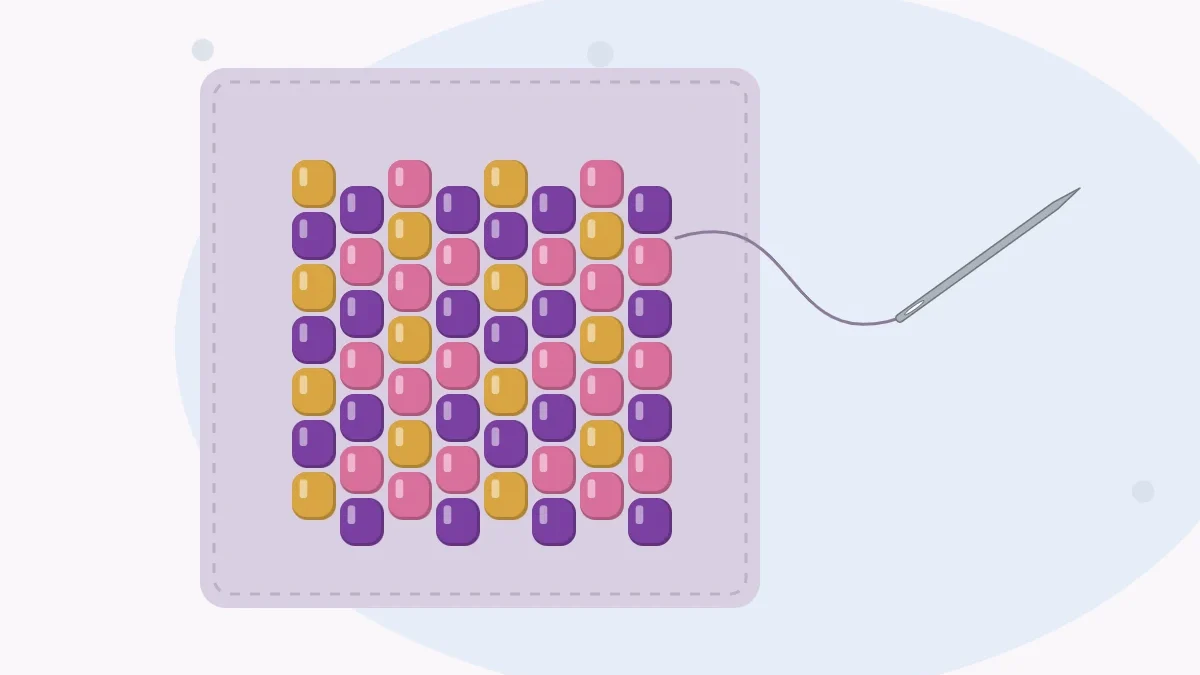
Bead weaving for beginners starts with one idea: instead of sliding beads onto a strand in a line, a needle and thread join the beads to each other, so they form a fabric, a shape or a flower. This guide covers off-loom bead weaving, which needs no equipment beyond a needle, thread and seed beads, and explains the four stitches most people learn first: ladder, brick, peyote and daisy chain.
What bead weaving is
In a strung bracelet, each bead touches the cord once and the cord does all the holding. In bead weaving, the thread passes through each bead two or more times and links it to its neighbors. The thread path is the pattern. Change the path and the same beads lie side by side, in offset rows or in small loops.
Almost every stitch can be understood by asking two questions. Which way do the bead holes point? And what is each new bead attached to: a neighboring bead, or a loop of thread?
Thread, needles and beads
- Beads. Seed beads in size 11/0 (about 2 mm wide) are the standard for weaving, but size 8/0 (about 3 mm) is easier to see and hold while learning. Cylinder seed beads have straight sides and lock together very evenly; round seed beads give a softer, more textured surface. Bead sizes are explained in the bead size guide.
- Thread. Nylon beading thread is the usual choice. Use it single, in a color close to the beads, and cut a comfortable working length of about an arm span.
- Needles. Beading needles are long, thin and flexible, with an eye barely wider than the shaft. Size 10 suits most work; size 12 is thinner for beads that must take many passes. The guide on how to thread a beading needle also covers stop beads, which keep the first beads from sliding off the tail.
The four beginner stitches
Ladder stitch: beads side by side
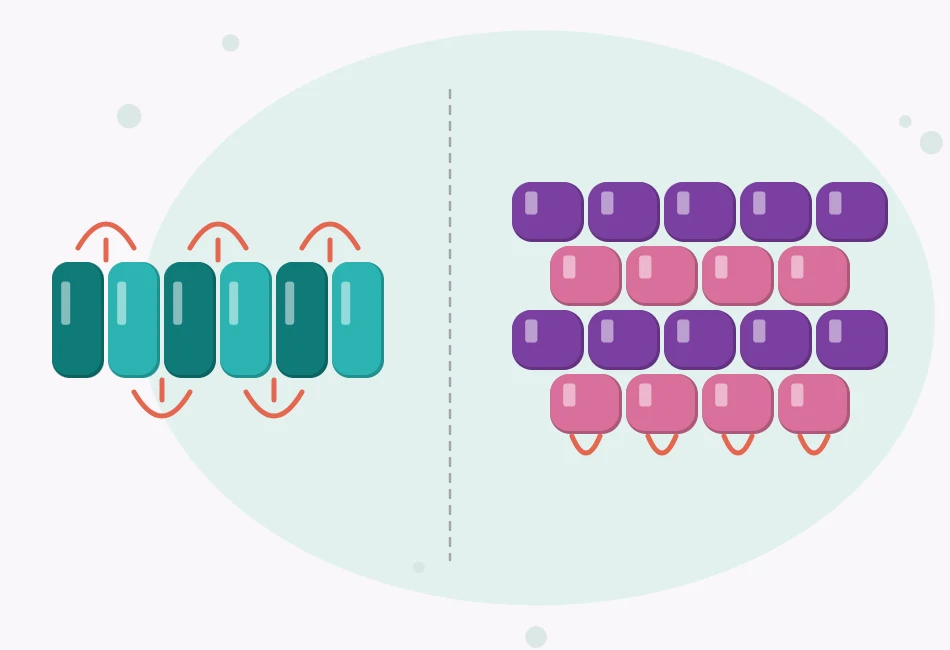
Ladder stitch joins beads in a single row with their holes parallel, like the rungs of a ladder. The thread circles through each pair of neighbors: out of one bead, through a new bead, and back through the first. Each stitch adds one bead and leaves a short span of thread between the beads along both edges.
A ladder is rarely the whole piece. Its main job is to be the foundation row for brick stitch, and those spans of thread along the edge are exactly what the next row needs.
Brick stitch: offset rows hanging from thread bridges
Brick stitch builds upward from a ladder. Each new bead is not sewn to another bead but hooked onto a thread bridge, the span of thread between two beads in the row below. The needle picks up a bead, passes under the bridge and goes back up through the same bead.
Because every bead sits over the join between two beads, the rows are offset by half a bead, like bricks in a wall. The holes point up and down. A row of six beads has only five bridges, so brick stitch narrows by one bead per row unless a bead is deliberately added at the edge. That is why triangles and diamonds are its natural shapes, as in the brick stitch earrings project.
Peyote stitch: offset columns with up-beads
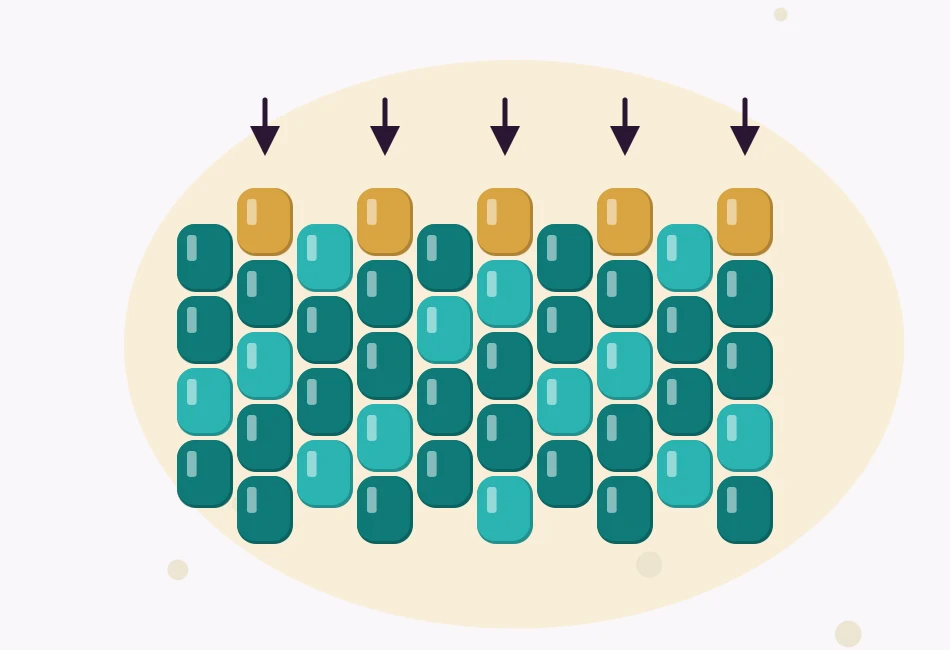
Flat peyote stitch looks similar to brick stitch turned on its side, but it is worked quite differently. It begins with a plain strand holding an even number of beads. On the way back, the needle picks up a bead, skips one bead of the strand and passes through the next. The skipped beads drop down and the new beads sit above them.
From then on the edge of the work is toothed. The raised beads are called up-beads, and each new bead fills the gap between two of them: pick up a bead, pass through the next up-bead, and repeat. The holes run along the row, so the thread travels from side to side in a zigzag. The Wikipedia article on peyote stitch gives more background.
Daisy chain: loops closed around a center
Daisy chain is the least fabric-like of the four. A small number of beads, often six or eight, is closed into a loop by passing through the first bead again. The thread then crosses the loop through a center bead and enters the bead on the opposite side. The result is a flower: petals around a center. A few plain beads between flowers turn the stitch into a chain, and a single flower makes a motif, as in the daisy chain bead ring.
The stitches compared
| Stitch | How the beads sit | Each new bead attaches to | Typical use |
|---|---|---|---|
| Ladder | One row, side by side, holes parallel | The previous bead | Foundation rows, narrow bands |
| Brick | Offset rows, holes up and down | A thread bridge in the row below | Triangles, diamonds, small shaped pieces |
| Peyote | Offset columns, holes along the row | An up-bead in the previous row | Flat bands, strips, tubes |
| Daisy chain | Loops of beads around a center | The first bead of its own loop | Flower chains, single motifs |
Tension: the skill behind every stitch
Tension is how firmly the thread is pulled after each stitch. It affects weaving far more than the choice of stitch does.
- If thread shows between the beads, the tension is too loose. Pull each stitch until the bead clicks into place, and hold the work between finger and thumb so it cannot slacken.
- If the piece curls or buckles, the tension is too tight. Flatten the work on the mat and ease the last few stitches.
- If the thread tangles, it is too long or twisted. Let the needle hang free so the thread untwists, and work with shorter lengths.
Tip
Practice each stitch with two colors of size 8/0 beads, alternating by row. The color change shows which beads belong to which row.
Which stitch to learn first
- Daisy chain. It is the closest to ordinary stringing, with a short, memorable path, and a finished flower appears within minutes.
- Ladder stitch. A row of ten beads teaches the circling thread path and steady tension.
- Brick stitch. Built on that ladder, it introduces thread bridges and shaping without any counting beyond the row length.
- Peyote stitch. The first two rows are fiddly because the beads have nothing firm to sit on yet.
Watch out
Seed beads and beading needles are small and sharp. Keep them away from young children and pets, and supervise children who are beading.
Frequently asked questions
What is the easiest bead weaving stitch for a beginner?
Daisy chain is the closest to ordinary stringing and gives a finished flower quickly. Ladder stitch is a good second step, because it is also the foundation row for brick stitch.
What is the difference between brick stitch and peyote stitch?
The finished beadwork looks similar, but in brick stitch each bead hangs from a thread bridge and the holes point up and down, while in peyote stitch each bead sits between two up-beads and the holes run along the row.
What size seed beads are best for learning bead weaving?
Size 8/0 beads, about 3 mm wide, are easy to see and handle. Size 11/0 beads, about 2 mm wide, are the standard for finished woven pieces once the thread paths are familiar.
Is a loom needed for bead weaving?
No. Ladder, brick, peyote and daisy chain are off-loom stitches worked with only a beading needle and thread.