Daisy Chain Bead Ring: One Flower on a Seed Bead Band
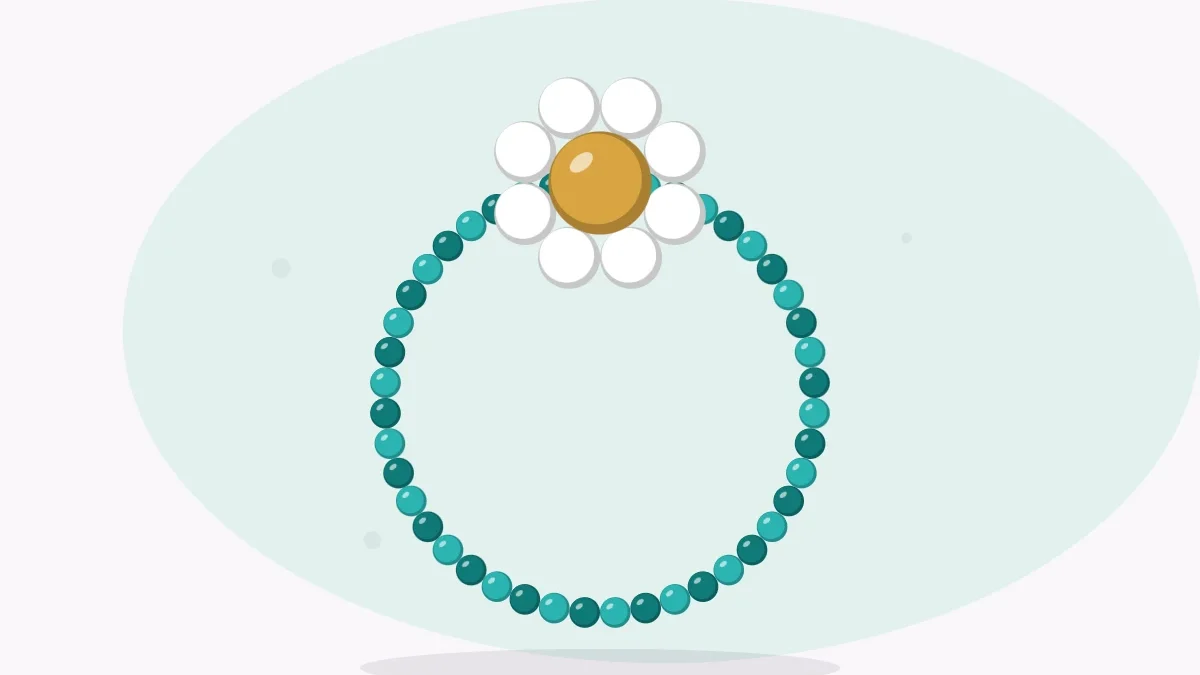
Eight seed bead petals around a 4 mm center bead make a single daisy on a plain seed bead band. The ring is stitched with needle and thread and finished by weaving back through.
Tutorial at a glance
Materials
- 8 size 8/0 seed beads for the petals
- About 20 size 8/0 seed beads for the band, plus spares
- 1 round bead, 4 mm
- Nylon beading thread, about 30 in (75 cm)
- Size 10 beading needle
- Small sharp scissors, ruler, paper strip and bead mat
A daisy bead ring is one small flower, eight seed bead petals around a round center bead, sitting on a plain band of seed beads. It is stitched with a needle and beading thread rather than strung on elastic, so the flower keeps its shape and no knot shows on the band. The whole ring uses about thirty beads.
What you need
- 8 size 8/0 seed beads for the petals
- About 20 size 8/0 seed beads in a second color for the band (19 to 22 depending on ring size), plus a few spares
- 1 round bead, 4 mm, for the flower center
- Nylon beading thread, about 30 in (75 cm)
- A size 10 beading needle
- Small sharp scissors, a ruler, a strip of paper and a bead mat
Use the thread single. If needles and thread are new territory, start with the guide on threading a beading needle.
Ring size and the band bead count
Beading thread does not stretch, so this ring has to slide over the knuckle. Wrap a paper strip around the widest part of the finger, mark where it overlaps and measure the strip in millimeters; the method is shown in how to measure for jewelry.
The arithmetic for a US size 7, which has an inside circumference of about 54.4 mm, goes like this. The thread runs through the middle of the beads, so the strung length must be longer than the finger by about three times the bead thickness: 54.4 + 9 = about 63 mm. The daisy takes up roughly 6 mm of that circle, leaving 63 − 6 = 57 mm for the band. Size 8/0 beads in a ring this small take about 2.9 mm each, and 57 ÷ 2.9 is close to 20. So a size 7 starts with 20 band beads, and the whole ring has 8 + 1 + 20 = 29 beads. Slimmer beads can take two or three more, which the test fit will show.
| US ring size | Inside circumference | Strung length | Band beads (size 8/0) | Total beads |
|---|---|---|---|---|
| 6 | 51.9 mm | about 61 mm | 19 | 28 |
| 7 | 54.4 mm | about 63 mm | 20 | 29 |
| 8 | 57.0 mm | about 66 mm | 21 | 30 |
| 9 | 59.5 mm | about 68.5 mm | 22 | 31 |
Seed beads vary by maker, so check a few against a ruler; one bead more or less changes the fit by roughly one ring size. Other sizes can be looked up in a ring size table and run through the same sum.
Stitch the daisy
Think of the petals as numbered 1 to 8 in the order they go onto the thread.
- Make the petal ring. Pick up 8 petal beads and slide them down until a 6 in (15 cm) tail is left. Tie the tail and the working thread together with a firm double knot so the beads close into a small circle. The knot sits between petal 8 and petal 1.
- Move into position. Pass the needle through petal 1, so the thread comes out between petal 1 and petal 2.
- Add the center. Pick up the 4 mm bead and lay it across the middle of the circle. Pass the needle through petal 5, entering on the side next to petal 6 and coming out on the side next to petal 4. The thread crosses the flower on a diagonal, which holds the center bead in the middle.
- Settle the flower. Pull gently until the petals close in around the center. The 4 mm bead is a little larger than the space inside the petals, so it sits slightly raised.
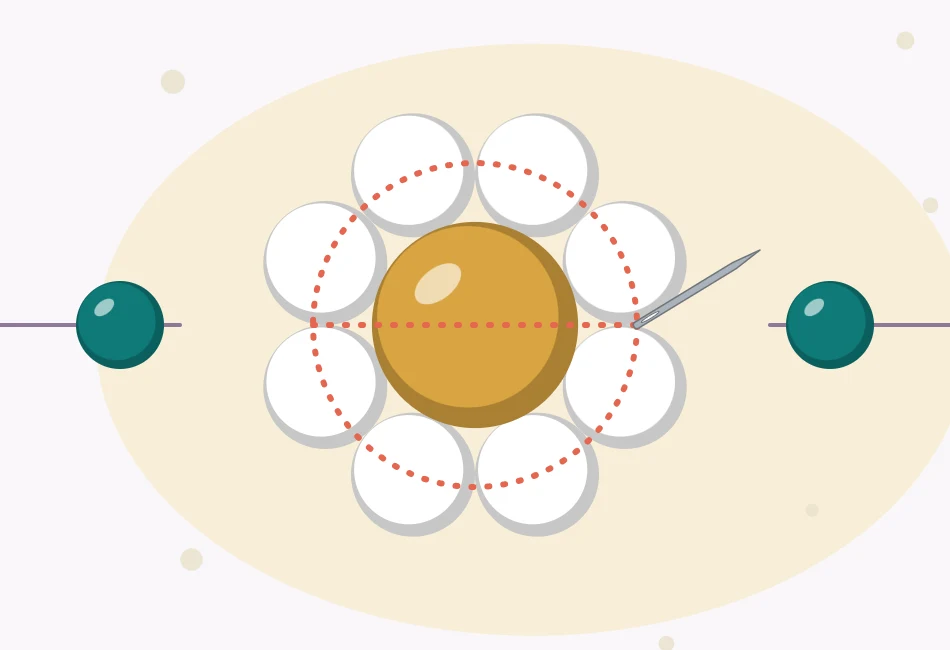
The thread now comes out between petal 5 and petal 4, directly opposite the knot.
Add the band and close the ring
- String the band. Pick up the band beads: 20 for a size 7, or the count from the table.
- Join the circle. Bring the band around and pass the needle through petal 1, entering on the side where the knot is. The thread comes out between petal 1 and petal 2 again. Pull until the band meets the flower with no thread showing.
- Test the fit. Slide the ring carefully over the knuckle. It should pass with slight resistance and sit without spinning. If it is tight or loose, pull the needle back out of petal 1, add or remove one band bead and join again.
- Reinforce the top of the flower. Pass through petals 2, 3 and 4. The thread is back at the start of the band.
- Reinforce the band. Pass through all the band beads again, a few at a time.
- Reinforce the bottom of the flower. At the knot, pass through petals 8, 7, 6 and 5, the half of the flower not yet strengthened. The thread comes out at the start of the band once more.
Tie off by weaving back through
- Weave in the working thread. Pass through the first 5 band beads. Slip the needle under the thread between two beads, pull until a small loop is left, pass the needle through the loop and tighten. This half-hitch knot hides between the beads.
- Bury the end. Pass through 4 more band beads and trim the thread close.
- Weave in the tail. Thread the starting tail onto the needle. Pass it through the band beads at the other end of the band, heading away from the flower, tie one half-hitch after 5 beads, pass through 4 more and trim.
Troubleshooting
- The center bead sits off to one side. The thread went into petal 5 from the wrong side. Unpick that stitch and enter next to petal 6.
- The petals gape around the center. The first knot was loose. Start again and tie the petal ring snugly; the eight beads should touch.
- The needle will not pass through a bead. The hole is full. Do not force it, because glass beads can crack. Skip to the next bead or change to a thinner needle.
Watch out
Seed beads and needles are small and easy to drop. Keep them away from young children and pets, and supervise children who are beading.
Variations
Three daisies. Replace band beads with extra flowers: string 2 band beads, stitch a daisy, and repeat. For each extra flower, pick up 8 petal beads and pass through the first one again to close the circle instead of tying a knot, then add the center as before. Each daisy fills about the same space as 2 band beads, so remove 2 from the count for every flower added.
A stretch version. For a ring that needs no needle at all, the seed bead stretch rings are strung on elastic. To see how daisy chain relates to the other beginner stitches, read bead weaving basics.
Frequently asked questions
How many beads does a daisy bead ring need?
A US size 7 takes 8 petal beads, one 4 mm center bead and about 20 size 8/0 band beads, 29 beads in all. Each ring size up or down changes the band by roughly one bead.
Why is the ring sized to the knuckle?
Beading thread does not stretch, so the ring has to slide over the widest part of the finger. Measure the knuckle with a paper strip and test the fit before reinforcing the band.
How is the center bead held in a daisy stitch?
After the eight petals are tied into a circle, the thread leaves petal 1, passes through the center bead and enters petal 5 on the opposite side. That diagonal crossing keeps the center bead in the middle.
Can the ring be made with smaller seed beads?
Yes. With size 11/0 petals, use a size 8/0 or 3 mm center bead and recount the band against a ruler, since about 17 to 18 size 11/0 beads fit in an inch.