Bead Size Guide: Millimeters, Seed Bead Sizes and Beads per Inch
How beads are measured, how seed bead numbers work, and how to turn any length into a bead count, with beads-per-inch tables for both.
A bead size chart answers the two questions every project starts with: how big is this bead, and how many are needed? Most beads are measured in millimeters, seed beads use their own numbering, and both convert into a simple beads-per-inch figure. The tables below give those figures, followed by the arithmetic for turning any length into a bead count.
How beads are measured in millimeters
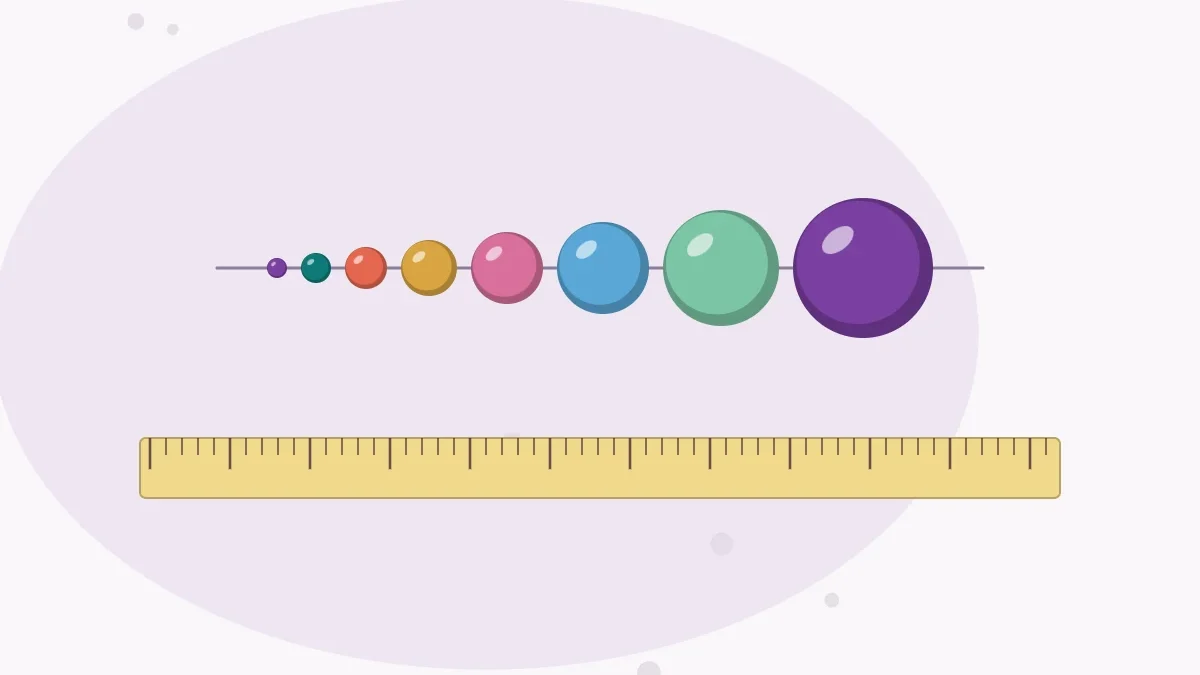
A bead’s size is its diameter: the distance across the bead at its widest point, at right angles to the hole. A 6 mm round bead is 6 mm across and, being a sphere, also 6 mm long along the hole. One inch equals 25.4 mm, so a 6 mm bead is just under a quarter of an inch.
For shapes that are not round, two numbers matter. A 6 mm rondelle may be 6 mm wide but only 4 mm long. The length along the hole is the one that fills a strand, so use it for counting.
Round bead size chart
Beads per inch is 25.4 divided by the bead diameter in millimeters. The last column shows the count for a 7 in (178 mm) strand, a common bracelet length.
| Bead size | Beads per inch | Beads in 7 in (178 mm) | Common uses |
|---|---|---|---|
| 3 mm | About 8.5 | About 59 | Spacers, delicate strands |
| 4 mm | About 6.4 | About 44 to 45 | Thin bracelets, earrings, accents |
| 6 mm | About 4.2 | About 30 | First bracelets, necklaces |
| 8 mm | About 3.2 | About 22 | Bolder bracelets, focal sections |
| 10 mm | About 2.5 | About 18 | Chunky strands, pendants |
| 12 mm | About 2.1 | About 15 | Statement pieces, wood beads |
Real beads vary slightly from their stated size, so treat every count as “about” and keep a few spares.
How seed bead sizes work
Seed beads are sized with a number followed by a slash and a zero, read as “aught”: size 11/0 is “eleven aught”. The system runs backward from what most people expect: the bigger the number, the smaller the bead. Size 6/0 beads are large and easy to handle; size 11/0 beads are small; size 15/0 are tiny.
| Seed bead size | Approximate width | Beads per inch | Beads in 7 in |
|---|---|---|---|
| Size 6/0 | About 4 mm | About 8 | About 56 |
| Size 8/0 | About 3 mm | About 11 | About 77 |
| Size 11/0 | About 2 mm | About 17 to 18 | About 119 to 126 |

Why the count is higher than the width suggests
The arithmetic for round beads does not quite work for seed beads. A size 8/0 bead is about 3 mm wide, yet about 11 fit in an inch, not 8.5. The reason is the shape: a seed bead is a short ring, wider than it is long, so each one fills only about 2.3 mm of the strand. Always use the beads-per-inch figure for seed beads, not the width.
Watch out
Seed bead sizes are approximate and vary by maker and even by color. Before trusting any chart, string one inch of your own beads against a ruler and count them.
More background on the numbering and the main seed bead shapes is in the Wikipedia article on the seed bead.
How to estimate how many beads a length needs
There are four short steps: find the strung length, convert it, divide, then round.
- Find the strung length. For a bracelet, anklet or ring, add ease to the body measurement: about three times the bead diameter. That is +0.5 in (12 mm) for 4 mm beads, +0.75 in (19 mm) for 6 mm and +1 in (25 mm) for 8 mm. Seed beads need about +0.25 to 0.4 in.
- Convert to millimeters. Multiply inches by 25.4.
- Divide by the bead size. Strung length in mm divided by bead diameter in mm gives the count. For seed beads, multiply the length in inches by the beads-per-inch figure instead.
- Round and add spares. Round to a whole bead, then buy a few extra.
Worked example: 6 mm bracelet
Wrist: 6.25 in. Ease for 6 mm beads: 0.75 in. Strung length: 6.25 + 0.75 = 7 in, which is 7 × 25.4 = 178 mm. Count: 178 ÷ 6 = 29.7, so about 30 beads. The easy elastic bead bracelet uses exactly this sum.
Worked example: seed bead bracelet
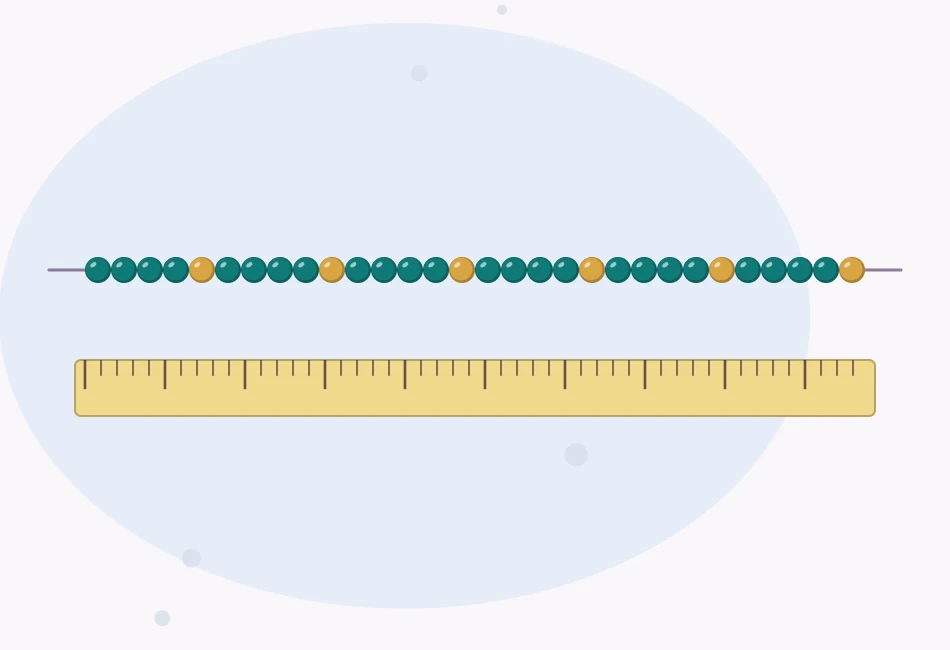
Wrist: 6.5 in. Ease for size 8/0 beads: about 0.3 in. Strung length: 6.8 in. Count: 6.8 × 11 = about 75 beads. The seed bead stretch bracelet shows how to fit a repeating pattern into a total like this.
Worked example: mixed sizes in a pattern
When a design mixes sizes, add up one repeat. Three 6 mm beads, one 4 mm spacer, three more 6 mm beads and another 4 mm spacer make 6 × 6 + 2 × 4 = 44 mm. Four repeats give 4 × 44 = 176 mm, which is close enough to 7 in (178 mm) for a stretch bracelet. That is 24 beads of 6 mm and 8 spacers.
Tip
If a count lands between two whole beads, round up for a stretch bracelet. A slightly loose fit is more comfortable than a tight one, and it puts less strain on the cord.
Choosing a size for the project
- Bracelets: 6 mm is the easy middle; 4 mm looks delicate and 8 mm bold.
- Necklaces: 6 to 8 mm for the main strand, with 10 to 12 mm kept for a few focal beads so the weight stays comfortable.
- Earrings: 4 to 8 mm, since larger beads add weight quickly.
- Rings and woven work: size 8/0 seed beads to learn with, size 11/0 for finer detail later.
Material changes how a size feels as well: the same 10 mm bead is light in wood and heavy in stone. The guide to types of beads compares them. For taking the body measurement itself, see how to measure for jewelry.
Frequently asked questions
How many 6 mm beads are needed for a 7 inch bracelet?
About 30. A 7 in strand is 178 mm, and 178 divided by 6 is 29.7, which rounds to 30 beads. Buy a few spares, since real beads vary slightly in size.
Which is bigger, a size 6/0 or a size 11/0 seed bead?
Size 6/0 is bigger. Seed bead numbers run backward: the bigger the number, the smaller the bead. Size 6/0 is about 4 mm wide, size 8/0 about 3 mm and size 11/0 about 2 mm.
How many seed beads are in an inch?
Roughly 8 beads of size 6/0, about 11 of size 8/0 and about 17 to 18 of size 11/0. These figures vary by maker, so string an inch of your own beads against a ruler and count.
How is a bead that is not round measured?
It has two measurements: the width across the bead and the length along the hole. The length along the hole is the one that fills the strand, so use it when counting beads for a project.