Stacked Stretch Bracelets: A Matching Set of Three
A coordinated stack of three stretch bracelets in 8 mm, 6 mm and 4 mm beads, with the strand length and bead count worked out for each size.

Tutorial at a glance
Materials
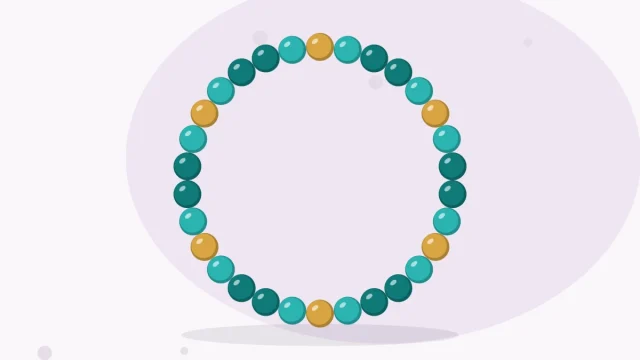
- 23 round 8 mm beads (22 navy, 1 gold)
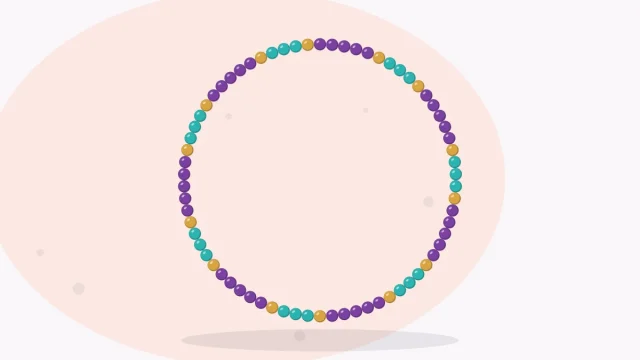
- 30 round 6 mm beads (25 medium blue, 5 gold)
- 43 round 4 mm beads (40 pale blue, 3 gold)
- A few spare beads of each size
- Clear elastic cord, 0.7 to 0.8 mm, two pieces of about 12 in (30 cm)
- Clear elastic cord, 0.5 mm, one piece of about 12 in (30 cm)
- Scissors, tape measure, bead mat, binder clips or tape
- Flexible jewelry glue (optional)
Stretch bracelets look best in a group, and a set of three in graduated bead sizes is an easy way to get a stack that sits well together. This set uses 8 mm, 6 mm and 4 mm round beads in one color family, shades of blue, with a gold bead as the accent that ties the three together. The method is the same for each bracelet; the only thing that changes is the length of the strand, and that is the part most first stacks get wrong.
What you need
- 23 round 8 mm beads: 22 in navy and 1 in gold
- 30 round 6 mm beads: 25 in medium blue and 5 in gold
- 43 round 4 mm beads: 40 in pale blue and 3 in gold
- Two or three spare beads of each size and color
- Clear elastic cord, 0.7 to 0.8 mm: two pieces of about 12 in (30 cm) for the 8 mm and 6 mm strands
- Clear elastic cord, 0.5 mm: one piece of about 12 in (30 cm) for the 4 mm strand, whose holes are smaller
- Scissors, a tape measure, a bead mat and three binder clips or pieces of tape
- Optional: flexible jewelry glue
The counts above fit a wrist of 6.25 in (159 mm). Other sizes are in the table further down. Beads are small parts; keep them away from young children and pets.
Why each bracelet needs a different length
If all three strands were strung to 7 in, the bracelet of large beads would feel tight and the one of small beads would hang loose. The reason is geometry. The length of a strand is measured through the center of the beads, but the wrist only touches the inner edge of the circle, and the inside is smaller than the strand by about three times the bead diameter. Bigger beads take away more room, so they need more ease:
- 4 mm beads: add about 0.5 in (12 mm) to the wrist measurement
- 6 mm beads: add about 0.75 in (19 mm)
- 8 mm beads: add about 1 in (25 mm)
The same rule is explained for necklaces, anklets and rings in the guide on how to measure for jewelry.
The arithmetic for a 6.25 in wrist
The bead count is the strung length in millimeters divided by the bead diameter.
- 8 mm strand: 6.25 in + 1 in = 7.25 in, which is 184 mm. 184 ÷ 8 = 23 beads.
- 6 mm strand: 6.25 in + 0.75 in = 7 in, which is 178 mm. 178 ÷ 6 = 29.7, so 30 beads (180 mm).
- 4 mm strand: 6.25 in + 0.5 in = 6.75 in, which is 171 mm. 171 ÷ 4 = 42.9, so 43 beads (172 mm).

Bead counts for other wrist sizes
| Wrist | 8 mm strand | 6 mm strand | 4 mm strand |
|---|---|---|---|
| 5.75 in (146 mm) | 6.75 in (171 mm): 21 beads | 6.5 in (165 mm): 28 beads | 6.25 in (159 mm): 40 beads |
| 6.25 in (159 mm) | 7.25 in (184 mm): 23 beads | 7 in (178 mm): 30 beads | 6.75 in (171 mm): 43 beads |
| 6.75 in (171 mm) | 7.75 in (197 mm): 25 beads | 7.5 in (190 mm): 32 beads | 7.25 in (184 mm): 46 beads |
| 7.25 in (184 mm) | 8.25 in (210 mm): 26 beads | 8 in (203 mm): 34 beads | 7.75 in (197 mm): 49 beads |
Counts are rounded to the nearest whole bead, so a finished strand can differ from the target by a few millimeters. Bead sizes also vary slightly between makers; lay the strand along a ruler before knotting if the fit matters.
Planning the colors
A stack reads as a set when the three bracelets share something. Here it is one hue in three depths, darkest on the largest beads, plus the same gold on every strand, placed differently each time:
- 8 mm: 22 navy beads and a single gold bead, which also marks where the knot is.
- 6 mm: a repeat of 5 medium blue and 1 gold, five times. 5 × 6 beads = 30 beads.
- 4 mm: 40 pale blue beads and 3 gold beads strung together as one short bar. 40 + 3 = 43 beads.
For a different wrist size, keep the gold beads as listed and change only the number of blue beads. To swap the palette, the guide to choosing bead color combinations shows how to pick a dominant color, a second color and an accent.
How to make the set
- Measure the wrist. Wrap a tape measure snugly just above the wrist bone and find the row in the table.
- Lay out three rows. Arrange each bracelet in its own row on the mat, in stringing order, and count each row twice.
- Cut and pre-stretch the cord. Cut three pieces of about 12 in (30 cm), using the thinner cord for the 4 mm beads. Pull each piece gently along its length four or five times so it does not relax later.
- String the 8 mm bracelet first. Clip one end of the cord about 2.5 in (6 cm) from the tip, then string the gold bead followed by the 22 navy beads.
- Test it on the wrist. Hold the ends together around the wrist. The beads should meet without the elastic stretching and without cord showing.
- Tie it off. Tie a surgeon’s knot: cross the ends and wrap twice, pull the circle closed, then cross the other way, wrap once and pull all four strands. Full steps are in the guide to tying off a stretch bracelet.
- Repeat for the 6 mm and 4 mm strands. Try each new bracelet on next to the finished ones before knotting it.
- Trim. Add a tiny dot of flexible glue to each knot if wanted, let it dry, and cut the tails to about 1/8 in (3 mm).
Tip
Start each strand with a gold bead so the knot always sits beside the accent. That makes the knot easy to find later and easy to turn to the inside of the wrist.
Troubleshooting the stack
- One bracelet rides higher than the others. It is too short for its bead size. Add one bead to the 8 mm strand, or two to the 4 mm strand, and retie.
- The 4 mm beads will not go onto the cord. Small beads have small holes. Use 0.5 mm elastic for that strand and cut the end at an angle for a sharper point.
Variations
A stack does not have to stop at three. A plain one-color strand, made exactly like the easy elastic bead bracelet, fills out the set without competing with it.
Frequently asked questions
Why are the three bracelets strung to different lengths?
The inside of a bead circle is smaller than the strand by about three times the bead diameter. Larger beads take up more of the space inside, so an 8 mm strand needs about 1 in of ease while a 4 mm strand needs only about 0.5 in.
How many beads does each bracelet need for a 6.25 in wrist?
About 23 beads of 8 mm (184 mm strand), 30 beads of 6 mm (180 mm strand) and 43 beads of 4 mm (172 mm strand).
Can all three bracelets use the same elastic cord?
Cord of 0.7 to 0.8 mm suits the 8 mm and 6 mm beads. Many 4 mm beads have holes too small for it, so 0.5 mm cord is the more reliable choice for the smallest strand.
How do the bracelets look like a set?
They share one color family and one accent. In this set each strand is a different shade of blue and each carries the same gold bead, placed differently on every bracelet.