Easy Elastic Bead Bracelet: A First Project in About 20 Minutes
A first beading project on stretch cord: measure the wrist, count about 30 round 6 mm beads, string them and close the circle with a surgeon's knot.

Tutorial at a glance
Materials
- About 24 round 6 mm beads in teal, plus a few spares
- 6 round 6 mm beads in gold, plus 1 or 2 spares
- Clear elastic cord, 0.7 to 0.8 mm, about 12 in (30 cm)
- Scissors
- Tape measure or paper strip and ruler
- Bead mat
- Binder clip or tape
- Flexible jewelry glue (optional)
An elastic bead bracelet is the simplest piece of beaded jewelry to make well: one length of stretch cord, about 30 round beads and a single knot. There is no clasp to attach and no pliers to master, so the whole project takes roughly 20 minutes once the beads are laid out. The steps below use 6 mm round beads in teal and gold, but the same method works for any pair of colors.
What you need
- About 24 round 6 mm beads in teal (the main color), plus 3 or 4 spares
- 6 round 6 mm beads in gold (the accent), plus 1 or 2 spares
- Clear elastic cord, 0.7 to 0.8 mm thick, about 12 in (30 cm)
- Sharp scissors
- A tape measure, or a paper strip and a ruler
- A bead mat or a folded towel, so the beads do not roll away
- A binder clip or a piece of tape to block one end of the cord
- Optional: a small drop of flexible jewelry glue for the knot
Glass, stone, wood and acrylic rounds all work. Cord of 0.7 to 0.8 mm suits most 6 mm beads; if a different bead or cord is on hand, the comparison of stringing materials explains which thickness goes with which hole. Beads are small parts, so keep them away from young children and pets.
Finished size and bead count
Measure the wrist just above the wrist bone, with the tape snug but not tight. Then add ease. A strand of beads closes into a circle that is measured through the middle of the beads, so the inside of the bracelet is smaller than the strand by about three bead widths. For 6 mm beads that means adding about 0.75 in (19 mm).
The arithmetic for the example bracelet: a 6.25 in wrist plus 0.75 in of ease gives a 7 in strand. Seven inches is 178 mm, and 178 divided by 6 is 29.7, so the bracelet needs 30 beads (30 × 6 mm = 180 mm). The guide to measuring for jewelry covers the same rule for other bead sizes.
| Wrist | Strung length | 6 mm beads | Teal groups between the 6 gold beads |
|---|---|---|---|
| 5.75 in (146 mm) | 6.5 in (165 mm) | 28 | Four groups of 4, two groups of 3 |
| 6.25 in (159 mm) | 7 in (178 mm) | 30 | Six groups of 4 |
| 6.75 in (171 mm) | 7.5 in (190 mm) | 32 | Four groups of 4, two groups of 5 |
| 7.25 in (184 mm) | 8 in (203 mm) | 34 | Two groups of 4, four groups of 5 |
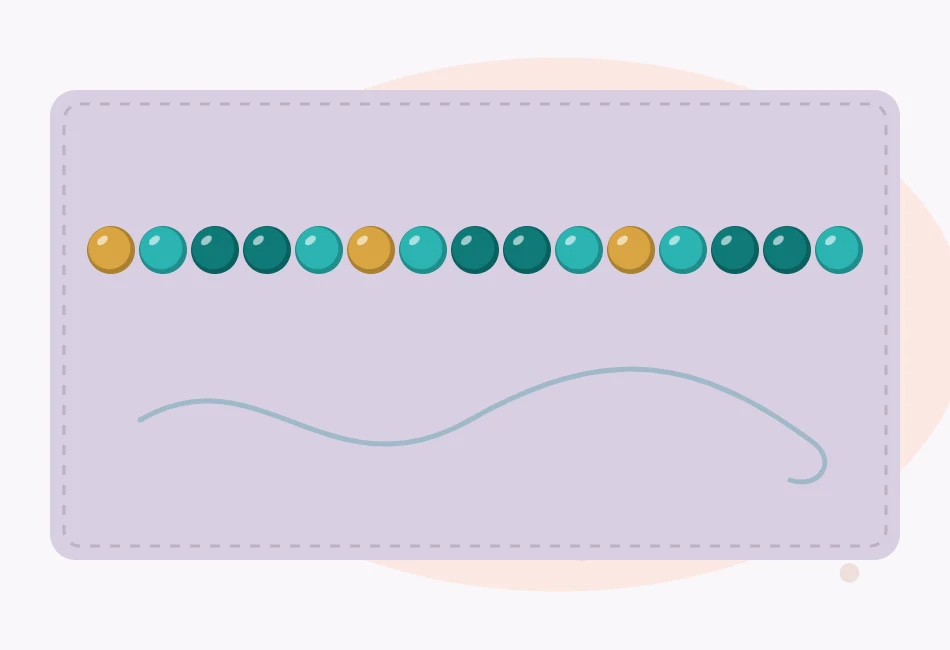
Each extra half inch of wrist adds two beads. The pattern is a repeat of 4 teal and 1 gold: six repeats make 30 beads, which is 24 teal and 6 gold. For the other sizes, keep the 6 gold beads and make a few teal groups one bead longer or shorter, placing the odd groups opposite each other so the bracelet still looks even.
How to make the bracelet
- Measure and count. Measure the wrist, add 0.75 in (19 mm) and read the bead count from the table. Measure, do not guess.
- Lay out the pattern. Line the beads up on the mat in order.
- Cut the cord. Cut about 12 in (30 cm) of elastic. That is the 7 in strand plus roughly 5 in (13 cm) for holding and knotting. Short tails make the knot much harder to tie.
- Pre-stretch it. Hold the cord in both hands and pull gently along its length four or five times. This keeps the bracelet from loosening after the knot is tied.
- Block one end. Fold a piece of tape over the cord, or attach a binder clip, about 2.5 in (6 cm) from one end.
- String the beads. Pick the beads up from the row in order and slide them down to the clip. Let them sit side by side without squeezing them together.
- Test the fit. Hold both ends and wrap the strand around the wrist. The first and last beads should touch with no cord showing and without the elastic being stretched. Add or remove a bead if needed.
- Tie a surgeon’s knot. Remove the clip. Cross the two ends and pass one under the other twice, as if starting a shoelace but with an extra wrap. Pull until the beads close into a circle. Then cross the ends again the other way, pass one under once and pull all four strands (two tails, two bracelet sides) firmly.
- Secure and trim. Add a pinhead-size dot of flexible glue to the knot if wanted and let it dry for the time on the label. Trim the tails to about 1/8 in (3 mm).
Tip
Tighten the knot by pulling the cord, not by pushing the beads. Stretch the bracelet sides slightly while pulling the tails so the knot seats itself under tension.
Finishing: the knot and where it goes
The surgeon’s knot holds on slippery elastic because the double wrap adds friction while the second half is tied. The article on knots that hold on a stretch bracelet shows the alternatives and when each is worth using.
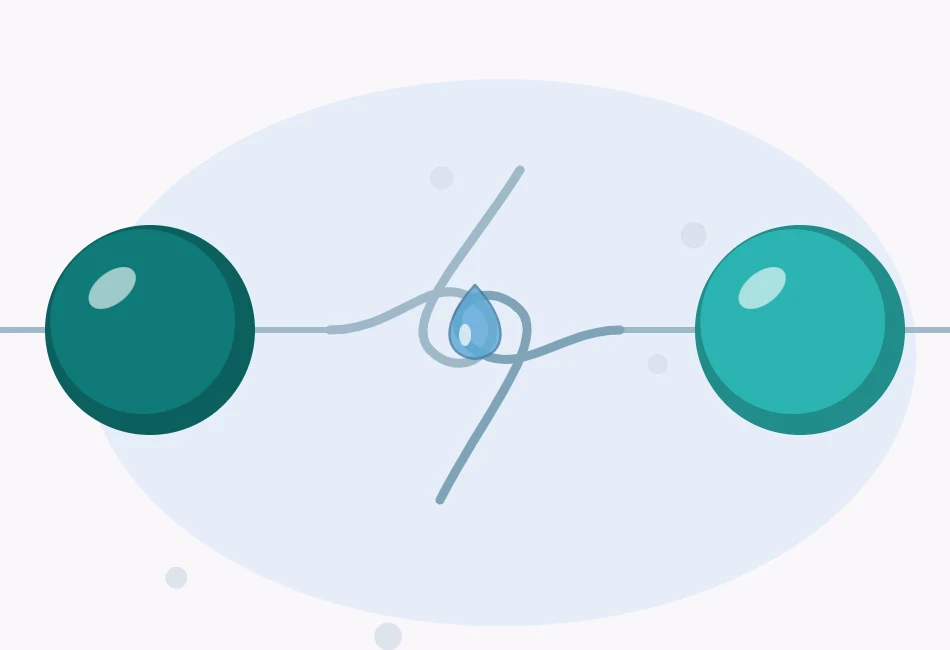
To hide the knot, stretch the bracelet gently and guide the knot into the hole of the bead next to it. This only works when the hole is wide enough. If the knot does not fit, do not force it: leave it between two beads and turn that part to the inside of the wrist.
Watch out
Rigid instant glue can make elastic brittle right at the knot. Use a glue described as flexible when dry, and keep it off the beads next to the knot.
If something goes wrong
- Cord shows between the beads. The knot was tied with slack in the strand. Untie it if the glue is not on yet, close the circle while pulling the first wrap, and retie.
- The bracelet leaves marks on the wrist. It is one or two beads short. Restring with the next size up in the table.
- The knot slides open. The second half was probably wrapped the same way as the first. Cross the ends in the opposite direction for the second pass and pull all four strands.
A next step
For a set, repeat the project in two other bead sizes; the counts and lengths for a stack of three stretch bracelets are worked out in a separate tutorial.
Frequently asked questions
How many 6 mm beads does an elastic bracelet need?
About 30 beads for a 7 in (178 mm) strand, which suits a wrist of about 6.25 in. Each extra half inch of wrist adds two beads, so a 6.75 in wrist needs about 32.
What thickness of elastic cord suits 6 mm beads?
Cord of 0.7 to 0.8 mm suits most 6 mm round beads. Thinner 0.5 mm cord is meant for seed beads and small holes, and 1 mm cord for large, heavy beads.
Why should elastic cord be pre-stretched?
New elastic relaxes slightly the first time it is pulled. Stretching it gently a few times before stringing means that slack appears before the knot is tied rather than after, so the beads stay close together.
Does the knot need glue?
A well-tightened surgeon's knot often holds without glue, but a very small dot of flexible glue adds security. Avoid rigid instant glue, which can make the elastic brittle at the knot.