Stringing Materials: Elastic Cord, Beading Wire, Thread and Cord Compared
Elastic cord, flexible beading wire, nylon thread and thicker cord compared side by side: diameters, what each suits and how each is finished.
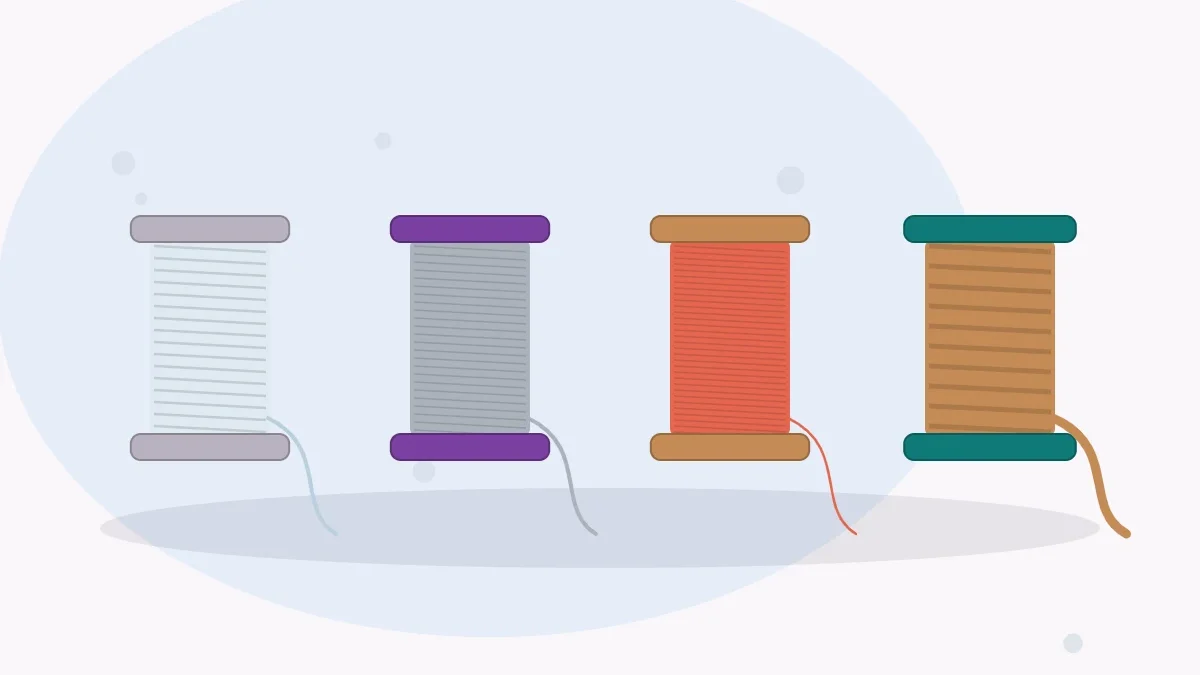
Bead stringing materials fall into four families: stretch elastic cord, flexible beading wire, nylon beading thread and thicker cord. Each one drapes differently, fits different bead holes and is finished in its own way, so the choice shapes the whole project. This comparison explains what each material is, which diameter to buy and how to pick the right one for the piece on your mat.
The four families compared
| Material | Common diameters | Drape | Best for | Finished with |
|---|---|---|---|---|
| Stretch elastic cord | 0.5 mm, 0.7 to 0.8 mm, 1 mm | Springs into a round loop | Bracelets, anklets and rings with no clasp | Surgeon’s knot, optional dot of glue |
| Flexible beading wire | 0.015 in (0.38 mm), 0.018 to 0.019 in | Smooth, slightly stiff curve | Necklaces and bracelets with a clasp, heavier beads | Crimp tubes |
| Nylon beading thread | Very fine, sold by letter or number size | Soft and limp | Seed beads, bead weaving | Knots and weaving the tail back through |
| Thicker cord | 0.5 to 2 mm | Soft, holds a knot visibly | Large-hole beads, knotted and pendant necklaces | Knots, sliding knots or cord ends |

Stretch elastic cord
Elastic cord stretches over the hand and springs back, so the piece needs no clasp. Clear round elastic is the usual choice because it disappears between the beads.
- 0.5 mm: seed beads and other small holes.
- 0.7 to 0.8 mm: 6 to 8 mm beads, the standard bracelet size.
- 1 mm: large, heavy beads such as 10 mm stone.
Cut the strung length plus about 4 to 6 in (10 to 15 cm) for knotting, and pull the cord firmly a few times before stringing so that it does its early stretching before it is tied. The finish is a surgeon’s knot; the steps are in the guide on how to tie off a stretch bracelet. Elastic wears with use, so expect to restring a bracelet that is worn often.
Flexible beading wire
Beading wire is not a single wire. It is a bundle of very fine steel strands inside a smooth nylon coating. More strands make a softer, more fluid wire; fewer strands make a stiffer, more economical one. Because it resists stretching and abrasion, it is the standard choice for necklaces, for glass and stone, and for anything with a clasp.
- About 0.015 in (0.38 mm): general stringing with 4 to 8 mm beads.
- 0.018 to 0.019 in (about 0.46 to 0.48 mm): heavier beads and longer strands.
Beading wire cannot be knotted securely. It is locked with 2 mm crimp tubes squeezed around the wire after it has looped through the clasp. Cut the finished length plus about 6 in (15 cm) so there is room to work at both ends. The method is explained in how to use crimp beads and crimp tubes, and a full project is the beaded bracelet with a clasp.
Watch out
A sharp kink in beading wire is permanent. Store it coiled loosely, and do not fold the strand while working.
Nylon beading thread
Beading thread is fine, strong and soft, made to pass through a seed bead several times. It is used with a beading needle for woven stitches such as ladder, brick and peyote, and for stringing very small beads. Because it has no stiffness of its own, a strung piece hangs limp and follows every curve.
Thread is finished without hardware: the tail is woven back through several beads, tied in small knots around the existing thread and trimmed. A thin coat of beeswax or thread conditioner helps reduce tangling. Bugle beads and other beads with sharp-edged holes can fray thread, so place a seed bead on each side of them.
Thicker cord: cotton, waxed and leather-style
Cord is meant to be seen. It becomes part of the design, either as visible knots between beads or as the necklace itself with a single pendant.
- Waxed cotton cord, 0.5 to 1 mm: grips its own knots well and comes in many colors. A good first cord.
- Plain cotton or braided nylon cord, 1 to 2 mm: soft, good for sliding knots and friendship-style pieces.
- Leather-style cord, 1 to 2 mm: round and smooth, suited to pendants and a few large beads.
Cord needs beads with holes to match, typically 1.5 mm or larger. Each knot also uses cord: allow about 3/8 to 1/2 in (10 to 12 mm) per overhand knot in 1 mm cord, and test with your own material. A knotted bead necklace shows the full cord arithmetic.
Which one for which project?
Work through these questions in order and stop at the first match.
- Is it a seed bead weave or made of very small beads? Nylon beading thread and a needle. For a simple strung seed bead bracelet, 0.5 mm elastic also works.
- Should it slip on with no clasp? Elastic cord, sized to the bead hole.
- Is the cord part of the look, or do the beads have large holes? Thicker cord with knots.
- Is it a necklace, or made of heavy glass or stone, with a clasp? Flexible beading wire and crimps.
If the first choice does not fit
- The cord will not go through the bead: drop to the next diameter, or set those beads aside for another piece.
- The bead slides over the knot: use a thicker cord, tie a double knot, or add a small bead beside the knot as a stopper.
- The strand looks stiff and will not curve: the beads are packed too tightly. Leave a hair’s width of slack before closing.
- The elastic shows between beads: the strand is too short for the wrist or the cord is too thin for the bead weight.
Tip
Take a few beads along when buying stringing material, or test the first bead as soon as an order arrives. Hole sizes are rarely printed on the package.
For a broader overview of the craft, see the Wikipedia article on bead stringing.
Frequently asked questions
What is the best string for beaded bracelets?
For a slip-on bracelet, clear elastic cord: 0.7 to 0.8 mm for 6 to 8 mm beads, 0.5 mm for seed beads and 1 mm for large, heavy beads. For a bracelet with a clasp, use flexible beading wire of about 0.015 in (0.38 mm) with 2 mm crimp tubes.
Can beading wire be tied in a knot?
Not securely. Flexible beading wire is springy and coated, so knots slip and kink the wire. It is finished with crimp tubes squeezed around the wire after it loops through the clasp.
How much stringing material should be cut?
For elastic, cut the strung length plus about 4 to 6 in (10 to 15 cm) for knotting. For beading wire, cut the finished length plus about 6 in (15 cm). For knotted cord, add the cord each knot uses as well.
What is beading thread used for?
Nylon beading thread is used with a beading needle for seed beads and woven stitches such as ladder, brick and peyote. It is fine enough to pass through a small bead several times and is finished by weaving the tail back through the beadwork.