How to Thread a Beading Needle and Start a Strand
Prepare the thread tip, lower the needle onto the thread, and secure the first beads with a stop bead. Includes needle sizes, thread length and ways to string with no needle at all.
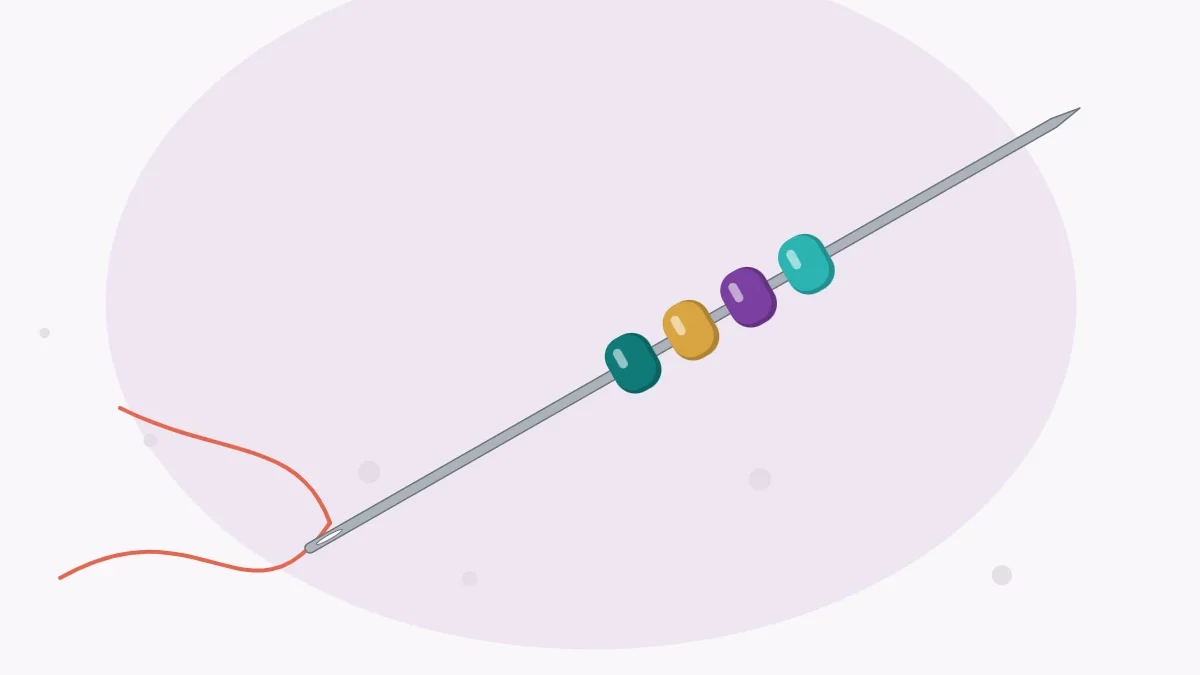
The trick to how to thread a beading needle is to prepare the thread end first and then bring the needle down onto the thread, rather than poking a soft thread at a tiny eye. With a clean, flat tip and the right needle size, threading takes a few seconds.
Choosing a beading needle size
Beading needles are long and thin, with an eye that is no wider than the shaft so the whole needle can pass through a small bead hole. They are numbered like seed bead sizes: the bigger the number, the finer the needle. Two sizes cover almost every beginner project.
| Needle | What it is like | Best for |
|---|---|---|
| Size 10 | Slightly thicker and stiffer, with a longer eye that is easier to thread | Size 8/0 and 6/0 seed beads, and size 11/0 beads when the thread passes through each bead only once or twice |
| Size 12 | Finer and more flexible, with a smaller eye | Size 11/0 beads in stitches that pass through the same bead several times, and any bead with a narrow hole |
A size 10 needle is the easier one to learn on. Keep a size 12 nearby for woven pieces such as brick stitch earrings.
Prepare the thread end
Most threading trouble comes from a fuzzy or rounded tip. Fix the tip and the eye stops being a problem.
- Cut cleanly. Use sharp scissors and cut the nylon beading thread at a slight angle so the end comes to a point.
- Flatten the tip. The eye of a beading needle is a narrow slot, not a round hole. Press the last 1/4 in (6 mm) of thread flat between a thumbnail and fingertip, or squeeze it gently with chain-nose pliers.
- Trim again if it frays. A tip that has split into fibers will not go through. Cut off a little and start with a fresh end.
The needle-to-thread method
- Hide the thread. Pinch the thread between thumb and forefinger so that only a speck of the flattened tip shows, about 1/16 in (1 to 2 mm). Held this short, the thread cannot bend away.
- Line up the eye. Hold the needle in the other hand, close to the eye, and turn it so the slot runs the same way as the flattened thread.
- Lower the needle onto the thread. Press the eye down over the tip between the pinched fingers. The fingers guide the thread into the slot.
- Pull the tail through. As soon as a whisker of thread shows on the far side, catch it and draw through 6 to 8 in (15 to 20 cm).
Tip
If the thread does not go in after a few tries, turn the needle over, since one face of the slot is often slightly more open than the other. Working in front of a plain white card also makes the eye easier to see.
Single or doubled thread
Single thread means one working strand with a short tail of 6 to 8 in (15 to 20 cm) hanging from the needle. It is the usual choice for bead weaving, because stitches can be undone and the bead holes have room for several passes.
Doubled thread means pulling the thread through until both ends meet, so two strands run through every bead. It suits simple stringing where the thread passes through each bead once. The trade-off is twice the bulk in each hole and stitches that are hard to unpick.
How much thread to cut
A comfortable working length is about one arm span, roughly 5 ft (1.5 m). Longer lengths tangle, fray and take longer to pull through each stitch. For doubled thread, cut two arm spans and fold it in half, which leaves the same working length.
Conditioning the thread
Thread conditioner or a small block of beeswax coats the fibers so they slide past each other. Draw the thread across the wax once, then pull it between two fingers to remove any excess. Conditioned thread tangles less and resists fraying against sharp bead edges. Some beading threads are sold already waxed or bonded and need nothing more.
Add a stop bead and start the strand
A stop bead keeps the first beads from sliding off the tail. It is temporary, so pick a spare bead in a color that stands out from the project.
- Pick up one bead and slide it down to about 6 in (15 cm) from the end of the thread.
- Pass the needle through the same bead again, in the same direction as the first time, so the thread wraps around the outside of the bead.
- Go through once more if the bead still slides too freely. It should hold its place but move when pushed.
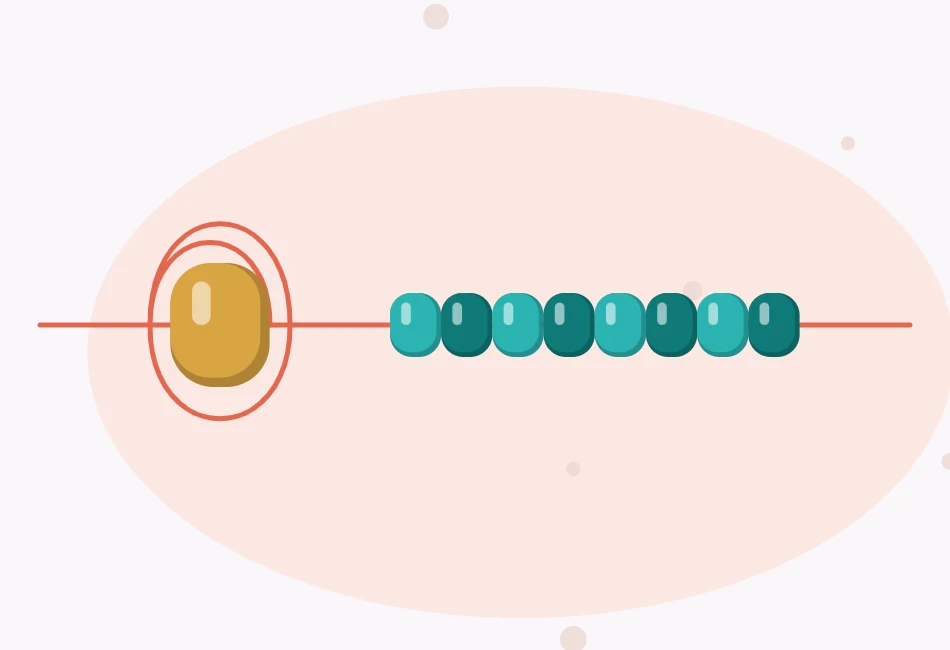
Now pour a small pile of beads onto the mat and scoop them up with the needle tip. Count as the strand grows: at about 11 beads per inch, a 7 in (18 cm) strand of size 8/0 seed beads takes about 77 beads, since 7 × 11 = 77. Seed beads vary between makers, so check the strand against a ruler. When the piece is finished, slide the stop bead off and weave the tail into the work. The four beginner stitches that begin this way are described in the guide to bead weaving basics.
Stringing without a needle
Not every strand needs a needle. Which shortcut works depends on the material, as the comparison of stringing materials explains.
- Stiffened end. Coat the last 1 in (2.5 cm) of cord or thread with a thin layer of clear nail polish or craft glue, let it dry completely, and trim the tip at an angle. The hardened end acts as a built-in needle.
- Twisted wire needle. This is a length of fine wire twisted into a shaft with a large loop for an eye. The loop collapses as it goes through the first bead, which makes it handy for the 0.5 mm elastic used in a seed bead stretch bracelet.
- No needle at all. Flexible beading wire is stiff enough to push straight through beads.
If something goes wrong
- The thread twists and knots. Let the needle hang freely so the thread can untwist.
- The needle will not go through a bead. Switch to a size 12 needle.
Watch out
Do not force a needle through a bead that is already full of thread, because a glass bead can crack. Needles and beads are small, sharp parts: store needles in a closed case and keep them away from young children and pets.
Frequently asked questions
What size beading needle is best for beginners?
A size 10 beading needle is the easier one to start with. It is a little thicker and has a longer eye, and it fits size 8/0 and 6/0 seed beads as well as size 11/0 beads when the thread passes through only once or twice. A size 12 needle is finer and helps when a bead hole is already crowded with thread.
Why does the thread keep fraying when it goes into the needle?
A frayed or rounded tip spreads out and catches on the sides of the eye. Cut the thread again at a slight angle with sharp scissors, flatten the last 1/4 in (6 mm), and pinch it so only a speck shows before lowering the needle onto it.
How long should beading thread be?
About one arm span, roughly 5 ft (1.5 m), is a comfortable working length. Longer thread tangles and wears more easily. For doubled thread, cut two arm spans and fold the length in half.
Is a stop bead part of the finished piece?
No. A stop bead is a temporary bead that the thread passes through twice to hold the first beads in place. It is slid off at the end, and the thread tail is woven into the work.