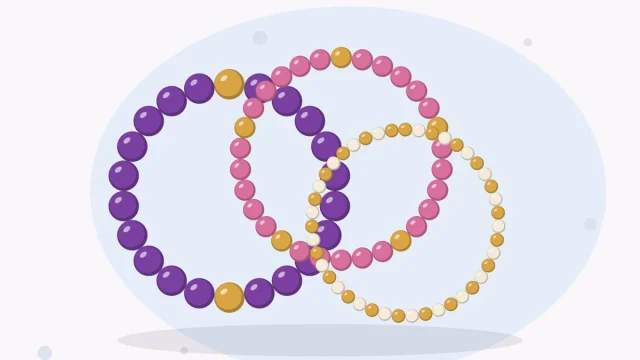
Memory Wire Bracelet: A Coiled Wrap with No Clasp
Three coils of memory wire, a small loop at each end and about 90 beads in between make a wrap bracelet that needs no clasp, knot or crimp.

Tutorial at a glance
Materials
- Bracelet-size memory wire, 3 full coils, about 2.25 in (57 mm) in diameter
- 76 round 6 mm beads, plus a few spares
- 15 round 4 mm metallic spacer beads, plus 2 spares
- Round-nose pliers
- Memory wire cutters or heavy-duty cutters rated for hardened steel
- Ruler and bead mat
- Chain-nose pliers and safety glasses (optional)
A memory wire bracelet is a coil of springy steel wire that keeps its round shape, so it wraps around the wrist and stays there without a clasp, a knot or a crimp. The only technique to learn is a small loop at each end, turned with round-nose pliers, which stops the beads from sliding off. This version uses three coils, which reads as three bracelets worn together but is a single piece.
What you need
- Bracelet-size memory wire, 3 full coils, about 2.25 in (57 mm) in diameter
- 76 round 6 mm beads, plus 4 or 5 spares
- 15 round 4 mm spacer beads in a metallic finish, plus 2 spares
- Round-nose pliers
- Memory wire cutters or heavy-duty cutters rated for hardened steel
- A ruler and a bead mat
- Optional: chain-nose pliers for adjusting the loops, and safety glasses for cutting
The overview of types of beads helps with choosing materials; lighter beads such as glass, wood or acrylic keep three coils comfortable. If you have sensitive skin, check what a finding is made of before you buy. Beads are small parts and cut wire ends are sharp, so keep both away from young children and pets.
Watch out
Never cut memory wire with ordinary jewelry wire cutters. The wire is hardened steel and leaves permanent notches in fine cutter blades. Use memory wire cutters or heavy-duty cutters, and point the end toward the mat when cutting so the offcut does not fly.
Finished size and bead count
Memory wire is sold in continuous coils, like a spring, and is not straightened before use. The wire needed is counted in coils, and the bead count comes from the circumference of one coil.
The arithmetic: one coil with a diameter of 57 mm has a circumference of 57 × 3.14 = about 179 mm, which is 7 in. Three coils are 3 × 179 = 537 mm, about 21 in of wire. Each end loop uses about 3/8 in (10 mm), so 20 mm in total, which leaves 517 mm for beads. In 6 mm beads alone that is 517 ÷ 6 = about 86 beads.
The pattern here mixes two sizes: groups of five 6 mm beads divided by single 4 mm spacers, with a short group of three at each end. That is 76 beads of 6 mm (456 mm) plus 15 spacers of 4 mm (60 mm), which adds up to 516 mm and 91 beads in all.
| Bead choice | Beads for 517 mm of wire | Length covered |
|---|---|---|
| 4 mm rounds only | About 129 | 516 mm |
| 6 mm rounds only | About 86 | 516 mm |
| 8 mm rounds only | About 64 | 512 mm |
| 6 mm rounds with 4 mm spacers (this pattern) | 76 and 15 | 516 mm |
Coil diameters differ between packs, so measure across one coil and redo the sum if it is not close to 57 mm. The bead size guide has beads-per-inch figures for other sizes. In practice, the wire is the final check: string until about 10 mm of bare wire is left.
How it fits
Because the coil opens and springs back, one bracelet adjusts to a range of wrists. On a small wrist the coils overlap a little more; on a larger wrist they spread. For a very small or very large wrist, use two and a half coils or three and a half, and change the bead count by about 15 beads of 6 mm per half coil (half of 179 mm is about 90 mm).
How to make the bracelet
- Cut three coils. Count three full turns from the end of the wire and cut with memory wire cutters. Keep the natural curve; do not try to straighten it.
- Turn the first loop. Grip the very tip of the wire in the round-nose pliers, about a third of the way up the jaws from the tips. Roll the pliers away from the coil, turning the wire around one jaw until the tip touches the wire again and forms a closed circle. Memory wire is stiff, so use a firm grip and turn in two or three short moves rather than one.
- Check the loop. The loop should be closed, with no gap a bead could catch in, and should curl toward the outside of the coil so the wire tip faces away from the skin.
- Lay out the pattern. On the mat, set out 3 large beads, 1 spacer, then 5 large beads and 1 spacer fourteen times, then 3 large beads.
- String the beads. Hold the coil by the open end and feed the beads on. They travel around the curve and stop at the loop.
- Check the remaining wire. Stop when about 3/8 in (10 mm) of bare wire is left. If more is left, add a bead or trim the extra. If less is left, remove a bead; a loop made from too little wire will not close.
- Turn the second loop. Push the beads back from the end, grip the tip and roll a loop as before, again curling toward the outside. The finished loop should sit close to the last bead, with a gap of only 1 to 2 mm so the beads can shift as the coil flexes.

Tip
Loop size depends on where the wire sits on the tapered jaws. Mark the spot on one jaw with a fine marker and both loops will match. The same rolling motion is used on softer wire in the tutorial for simple bead drop earrings.
If this happens, do that
- The loop will not close. There is not enough wire, or the grip was too far from the tip. Remove one bead and roll again, starting right at the end of the wire.
- The loop is a teardrop, not a circle. The wire slipped in the jaws partway through. Open the loop slightly with chain-nose pliers and re-roll it; hardened wire tolerates one correction but can snap if bent back and forth.
- Beads will not slide past the curve. Long tube-shaped beads bind on a tight coil. Keep to round or short beads, or place long ones singly between rounds.
Variations
A single coil plus about an inch of overlap makes a slim bangle: 179 mm plus 25 mm, less 20 mm for the loops, leaves 184 mm, or about 31 beads of 6 mm. For a longer wrap, cut five coils (895 mm) and plan on about 146 beads. Memory wire is one of several wire types used in beading, and the article on jewelry wire explains how gauge and hardness differ. For another quick piece with no clasp, see the summer beaded anklet.
Frequently asked questions
How many beads does a three-coil memory wire bracelet need?
Three coils of about 57 mm across give roughly 537 mm of wire. After about 10 mm for each end loop, 517 mm is left, which takes about 86 beads of 6 mm, 64 beads of 8 mm or 129 beads of 4 mm.
Why can memory wire not be cut with regular wire cutters?
Memory wire is hardened steel. It leaves permanent notches in the blades of fine jewelry cutters, so it should only be cut with memory wire cutters or heavy-duty cutters made for hard wire.
How are the ends of memory wire finished?
The simplest finish is a small closed loop at each end, rolled with round-nose pliers from about 3/8 in (10 mm) of bare wire. The loop stops the beads and keeps the cut tip away from the skin.
Does a memory wire bracelet have to be sized to the wrist?
Not precisely. The coil opens and springs back, so one bracelet adjusts to a range of wrists. For a very small or very large wrist, cut half a coil less or more.