Beaded Hoop Earrings: Threading Beads onto Wire Hoops
Slide beads onto ready-made wire hoops and bend the tip of the wire up to latch. The bead count comes from the hoop's circumference minus the section left bare.
Tutorial at a glance
Materials
- 2 beadable wire hoops, about 1 in (25 mm) across
- 20 round beads, 4 mm, plus a few spares
- Chain-nose pliers
- Ruler and bead mat
Beaded hoop earrings are about as simple as earring making gets, because the hoop does most of the work. Ready-made beadable wire hoops have a small loop at one end and a straight wire at the other: beads slide on, the tip of the wire is bent up to latch into the loop, and the earring is done. The only planning needed is working out how many beads fit, and that comes straight from the size of the hoop.
What you need
- 2 beadable wire hoops, about 1 in (25 mm) across, with a loop at one end and a straight wire end
- 20 round beads, 4 mm (10 per hoop), plus a few spares; the pattern below uses 12 teal, 4 gold and 4 white
- Chain-nose pliers
- A ruler and a bead mat
Beadable hoops are sold in several diameters and wire thicknesses, and they are described along with the other common parts in the earring findings guide. The wire is often around 20- to 22-gauge (0.8 to 0.64 mm); a table of American wire gauge sizes converts other gauges to millimeters. What matters in practice is that the bead holes are wider than the wire.
Tip
Before planning a pattern, slide one bead of each kind onto the straight end and push it all the way around the curve. A bead that sticks on the curve will not sit properly, however well it fits on the straight tip.
How many beads fit on a hoop
The wire of a hoop is a circle, so its length is the diameter multiplied by 3.14. A 25 mm hoop has about 25 × 3.14 = 78.5 mm of wire, a little over 3 in.
Not all of that wire can carry beads. The last 1/8 in (3 mm) of the straight end is bent up to form the latch, and the stretch of wire next to it passes through the ear and must stay bare. For a hoop with beads along the lower half, as in this project, leave about 1.5 in (38 mm) bare in total. That gives 78.5 − 38 = 40.5 mm of beaded wire, and 40.5 ÷ 4 = 10 beads of 4 mm, which take up 40 mm.
The same sum works for any hoop and any bead. Seed beads are the one case that needs care: they are counted per inch of strung length rather than by their width. Size 8/0 beads run at about 11 per inch, so 40 mm (about 1.6 in) holds roughly 17 of them. Seed beads vary by maker, so string a few against a ruler and check. The bead size guide has the full beads-per-inch table.
| Hoop diameter | Wire length | Beaded section (lower half) | 4 mm beads per hoop |
|---|---|---|---|
| 3/4 in (19 mm) | about 60 mm | about 30 mm | 7 |
| 1 in (25 mm) | about 78.5 mm | about 40 mm | 10 |
| 1.25 in (32 mm) | about 100 mm | about 50 mm | 12 |
For a fuller look on the 1 in hoop, leave only about 7/8 in (22 mm) bare. That gives 78.5 − 22 = 56.5 mm, which is 14 beads of 4 mm (56 mm). Do not fill a hoop further than that: the wire needs free space to pass through the ear.
Plan the pattern
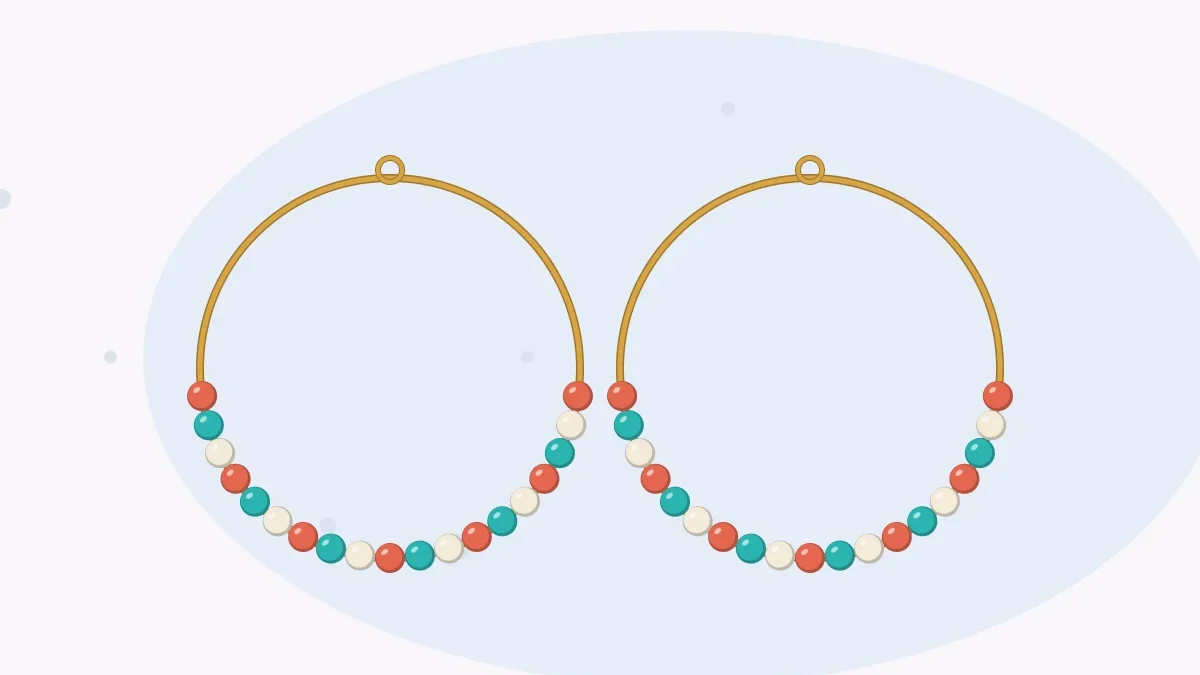
A hoop is seen from the side with the lowest point in the middle, so symmetric patterns look best. With an even count of ten there are two middle beads. The pattern used here reads, from one side to the other: 3 teal, 1 gold, 2 white, 1 gold, 3 teal. That is 3 + 1 + 2 + 1 + 3 = 10 beads. Two hoops need 12 teal, 4 gold and 4 white, which is 20 beads in all.
Lay both rows out on the mat before threading anything. If choosing colors is the hard part, see the guide to bead color combinations.
Thread and close the hoops
- Check the wire end. Some hoops arrive with the tip already bent. If the beads will not pass the bend, straighten the tip gently with the chain-nose pliers. Do this once only; rebending weakens wire.
- Thread the first hoop. Hold the hoop by its loop end and slide the ten beads onto the straight end in pattern order. Let them run down to the bottom of the curve.
- Check the spacing. Hold the hoop up as it will hang. The beads should settle along the lower half, with bare wire on both sides. Measure the bare straight end: at least 5/8 in (16 mm) should be free for the ear and the latch.
- Bend the latch. Grip the last 1/8 in (3 mm) of the straight end in the tip of the chain-nose pliers and bend it up to roughly a right angle, pointing away from the center of the hoop. Press the two ends of the hoop toward each other and let the bent tip hook into the small loop.
- Test the catch. Open and close the hoop twice. The tip should hook into the loop without being forced and stay there. If it slips out, make the bend a little sharper.
- Make the second hoop. Thread the second row of beads in the same order and latch it the same way.
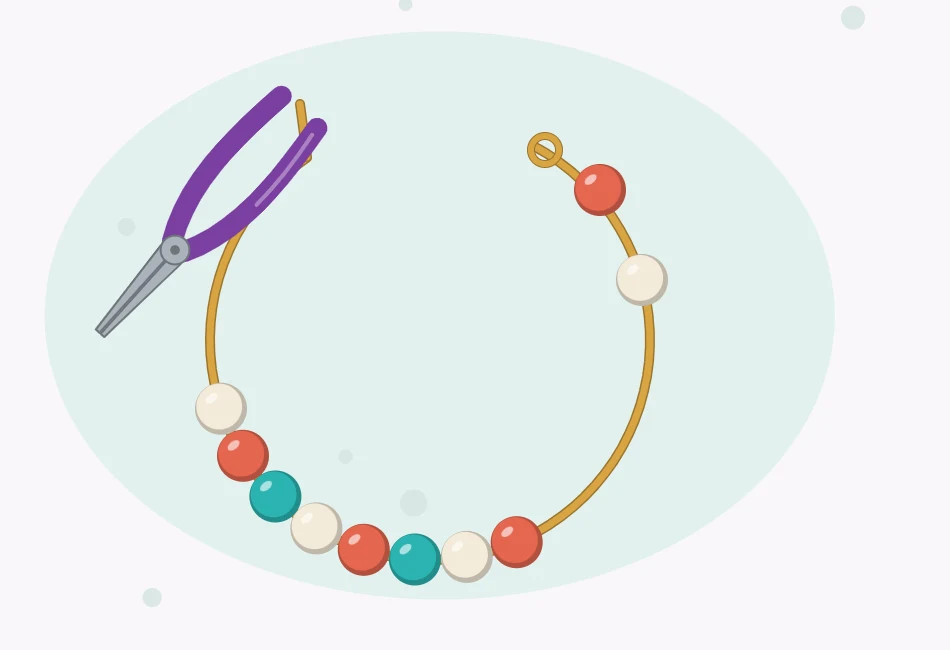
To wear the earrings, unhook the tip, pass the straight end through the ear from the front and latch it behind the earlobe.
If this happens, do that
- The beads slide up toward the latch. On a half-filled hoop the beads are free to move and settle at the lowest point when worn. If that movement is unwelcome, use the fuller count of 14 beads so there is less room to travel.
- The hoop has turned oval. Too much pressure while bending the tip pulls the circle out of shape. Slide the hoop over a round marker or a thick pen and press it gently back into a curve.
- The hoops do not match. Count the beads on each one. A single extra bead shifts the pattern off center.
Watch out
Beads and hoops are small parts. Keep them away from young children and pets, and supervise children who are beading.
Variations
Seed bead hoops. Fill the lower half with about 17 size 8/0 seed beads in one color, or in three blocks of 6, 5 and 6.
A center drop. Thread five 4 mm beads, then a small bead drop by its loop, then five more beads. The drop hangs at the lowest point of the hoop. The loop is the one taught in the simple bead drop earrings tutorial, and it must be large enough to slide over the hoop wire.
Frequently asked questions
How many beads fit on a 1 in hoop?
A 25 mm hoop has about 78.5 mm of wire. With beads along the lower half only, about 40 mm is beaded, which is 10 round 4 mm beads. A fuller hoop takes about 14. Always leave bare wire for the ear and the latch.
How does a beadable hoop close?
One end has a small loop and the other is a straight wire. After the beads are on, the last 1/8 in (3 mm) of the straight end is bent up to about a right angle so it hooks into the loop.
Can seed beads be used on wire hoops?
Yes, as long as the holes fit over the wire. Size 8/0 and 6/0 seed beads usually pass; smaller sizes may not. Slide one bead around the whole curve before planning the pattern.
Why do the beads move around on the hoop?
On a half-filled hoop the beads are free to slide and settle at the lowest point when the earring is worn. Adding more beads leaves less room for them to travel.