Jewelry Clasps and Jump Rings: Types and How to Attach Them
The six clasp types beginners meet most, the difference between jump rings, split rings and soldered rings, and the sideways twist that opens a jump ring without spoiling its shape.
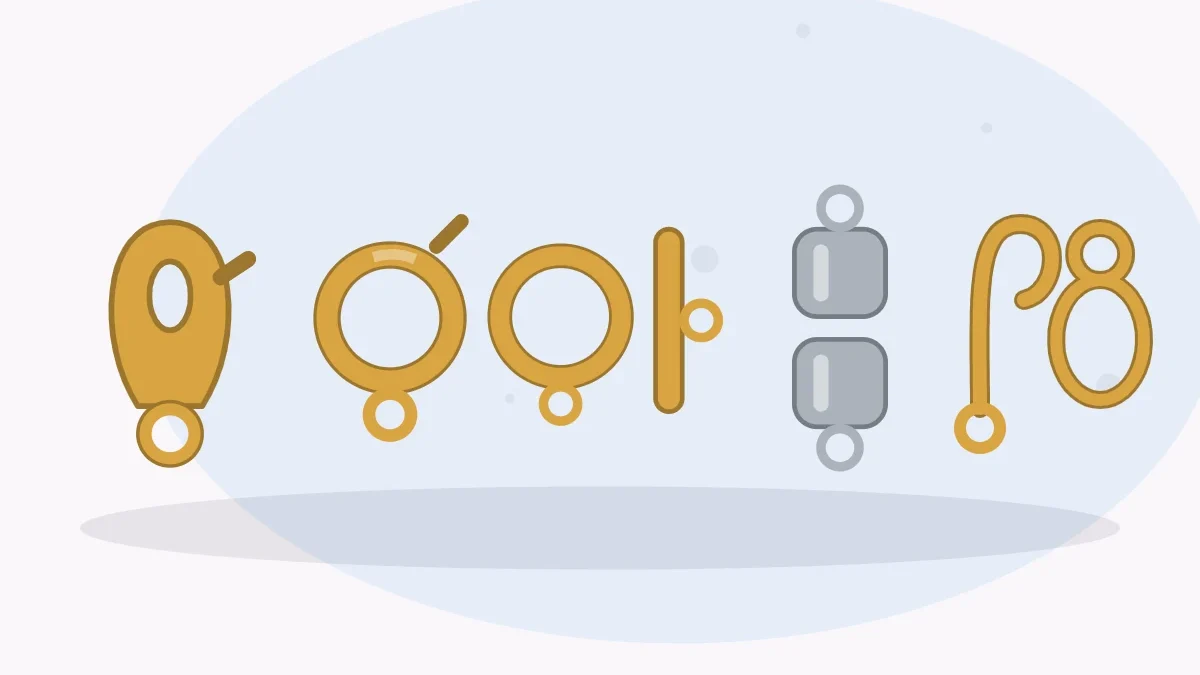
Jewelry clasps and the small rings that connect them decide whether a finished piece is easy to put on and whether it stays on. Six clasp types cover nearly everything a beginner will make, and one habit, opening a jump ring sideways instead of pulling it apart, prevents most of the failures that happen at the join.
The main clasp types
| Clasp | How it works | Suits | Keep in mind |
|---|---|---|---|
| Lobster clasp | A spring-loaded lever opens a hook that closes around a ring | Bracelets, necklaces and anklets of almost any weight | Needs a fingernail to work the lever; larger sizes are easier to handle |
| Spring ring | A tiny pin slides back inside a hollow ring | Light, fine necklaces and delicate strands | Small and fiddly; not for heavy beads |
| Toggle | A bar passes through a ring and lies across it | Bracelets and chunky necklaces; easy to fasten with one hand | Relies on the weight of the piece to hold; the bar needs room to turn |
| Magnetic | Two halves snap together | Light necklaces and bracelets for anyone who struggles with small levers | Can pull apart under a tug or a heavy strand |
| Hook and eye | A shaped hook slips into a loop or ring | Necklaces, where the weight keeps the hook seated | Can unhook on a loose bracelet |
| Slide clasp | A tube slides into a sleeve, with several loops along each half | Multi-strand bracelets and flat woven bands | Loops must match the number of strands or the width of the band |
Choosing between them
- For a first strung bracelet, a lobster clasp of about 1/2 in (12 mm) with a ring on the other end is the dependable choice. It is the one used in the beaded bracelet with a clasp.
- For a bracelet that has to be fastened one-handed, a toggle is the easiest to manage.
- For a heavy necklace, pick a lobster clasp, a toggle or a hook and eye. Leave magnetic clasps and small spring rings for light strands.
Scale matters as much as type: a large clasp overwhelms a strand of seed beads, and a tiny one looks lost next to 10 mm beads. Remember that the clasp section adds length. A lobster clasp with its ring and two crimps takes up roughly 0.75 to 1 in (19 to 25 mm), so the beaded part of a 7 in (18 cm) bracelet is only about 6 to 6.25 in (15 to 16 cm).
Watch out
Toggles need slack. The last few beads next to the bar must be small enough, about 4 mm or less, for the bar to fold back and pass through the ring. If the bar will not go through, replace the last two or three beads with smaller ones.
Jump rings, split rings and soldered rings
Clasps are rarely attached straight to the beads. A small ring links the clasp to the strand and gives the lobster hook something to close around.
- A jump ring is a circle of wire with one cut in it. It opens and closes with pliers, which makes it the everyday connector for clasps, charms and extender chains. Its weak point is the cut: thin cord or beading wire can slip through a gap that is not fully closed.
- A split ring is a tiny double coil, like a key ring. There is no gap, so nothing can slide out, but it is thicker and slower to attach. Slide the part onto the end of the coil and turn it around until it drops into the center.
- A soldered ring, also sold as a closed ring, has no opening at all. It cannot be opened, so it is strung on like a bead: the beading wire loops through it and is held with a crimp, as shown in the guide on how to use crimp beads. It is the most reliable ring to pair with a lobster clasp.
How to open and close a jump ring
A jump ring keeps its strength only if it stays round. Pulling the two ends away from each other into a wide gap stretches the circle, and it will not return to a tidy join. The ends should be twisted past each other instead, one toward the body and one away, like opening a door.
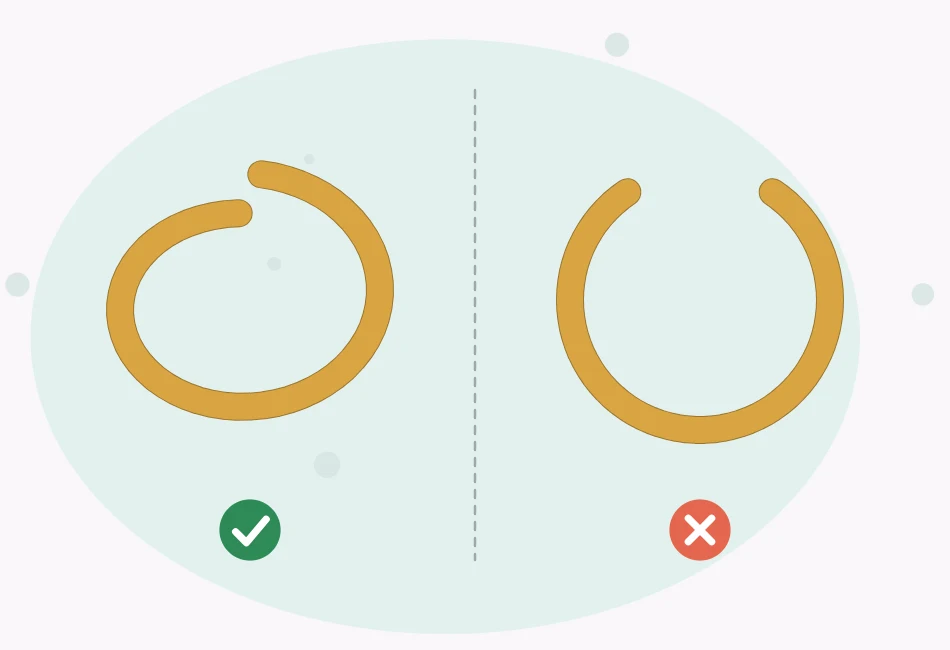
- Grip both sides. Hold the ring with two pairs of pliers, chain-nose or flat-nose, with the cut at the top between them. Each pair holds one side of the ring.
- Twist, do not pull. Push one hand away and bring the other toward the body until the gap is just wide enough for the clasp or loop to slide on.
- Add the parts. Slip on the clasp, charm or chain link.
- Twist back. Reverse the movement until the ends meet. Go a hair past the meeting point and back again, pressing the ends toward each other slightly, so they sit flush.
- Check the join. Run a fingertip over the cut. There should be no step and no visible gap.
Tip
The same sideways twist opens the loop of an ear wire, an eye pin or a simple wire loop on a bead drop.
Matching ring size and gauge to the piece
A jump ring is described by its diameter and by the thickness of its wire, given as a gauge. A lower gauge number means thicker wire. Thicker wire and a smaller diameter make a stiffer ring that is harder to pull open by accident.
| Wire | Typical ring diameter | Use |
|---|---|---|
| 22-gauge (0.64 mm) | 3 to 4 mm | Light earrings and small charms |
| 20-gauge (0.8 mm) | 4 to 6 mm | Most bracelets and necklaces with 4 to 8 mm beads |
| 18-gauge (about 1 mm) | 5 to 8 mm | Heavy strands, large clasps and toggles |
If a ring bends open during normal wear, move to a thicker gauge, a smaller diameter or a soldered ring. For an 18 in strand such as the simple beaded necklace, a 20-gauge ring of about 5 mm on one end and a lobster clasp on the other is a balanced pairing.
Buying and storing findings
- Buy clasps and rings in one metal color so the ends of a piece match its spacers. Ear wires and pins are covered separately in the guide to earring findings.
- Keep sizes apart in labeled compartments; a 4 mm and a 5 mm ring are hard to tell apart loose.
- If you have sensitive skin, check what a finding is made of before you buy.
- Clasps, rings and magnets are small parts. Store them closed and out of reach of young children and pets.
Frequently asked questions
What is the easiest clasp for a beginner to use?
A lobster clasp of about 1/2 in (12 mm) paired with a ring is the usual starting point. It closes positively, suits most bracelets and necklaces, and is simple to attach with a crimp or a jump ring.
Why should a jump ring be twisted open instead of pulled apart?
Pulling the ends apart stretches the circle, and the ring will not close back into a round shape with a tight join. Twisting one end toward the body and the other away keeps the curve intact, so the ends meet flush again when the movement is reversed.
What is the difference between a jump ring and a split ring?
A jump ring is a single circle of wire with one cut, opened and closed with pliers. A split ring is a double coil like a tiny key ring with no gap, so thin wire or cord cannot slip out, but it is bulkier and slower to attach.
Which jump ring gauge suits a beaded bracelet?
A 20-gauge (0.8 mm) ring of about 4 to 6 mm suits most bracelets with 4 to 8 mm beads. Heavier strands and large clasps are better matched with 18-gauge rings or a soldered ring.